Small Business Enterprise & Workforce Goals
Equal Opportunity Programs
OCII is committed to the economic benefits that extends beyond providing affordable housing and into the realm of employment and business opportunities. OCII promotes equal opportunity in contracting and employment among professional services consultants and construction contractors through its Small Business Enterprise (“SBE”) Program and its Local Construction Workforce Hiring Program. Each program has a robust goal of 50% for SBE engagement and local construction employment, and both programs are enforced by OCII’s Contract Compliance Division. All contracts for construction are also subject to OCII’s Prevailing Wages Policy, which requires the payment of prevailing wages.
Annual OCII Small Business Enterprise, Workforce and Trainee Reports
Small Business Enterprise
Under OCII’s SBE Policy, prime contractors on OCII-assisted projects must make a good faith effort to award 50% of contract dollars to bona fide SBEs that hold valid certifications and fall within certain revenue thresholds. Additionally, OCII recognizes the Local Business Enterprise ("LBE") certified by the City and County of San Francisco (“City”) is consistent with OCII SBE size standards. Under OCII’s SBE program, Project Area businesses bidding on agency-assisted contracts are given first consideration, followed by San-Francisco based SBEs, and then non-SF based SBEs.
FY 24 -25, OCII’s developer partners awarded professional services contracts to one affordable housing project, Mission Bay Block 4 East, totaling $9.5 million. No new construction contracts were in active buyout for OCII-assisted housing or commercial developments. This is attributed to the market cycles and normal phases of real estate development which often span multiple years.
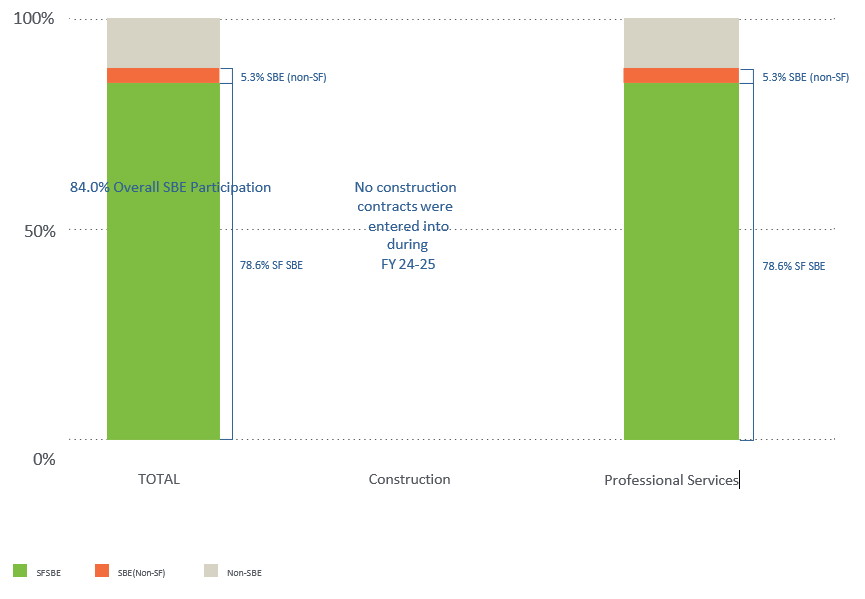
Notably, small businesses were over $8 million (84.0%) of professional services contracts, and of the total, 78.6% were awarded to SF-SBEs (LBEs). No projects awarded new construction contracts in this time-period. (See Chart 1).Minority and women owned firms received nearly $4.9 million (51.5%) of professional service contracts. Y.A. Studios, an African American architectural firm, is the lead architect for Phase 1 and Phase 2 of Mission Bay Block 4 East.
To ensure inclusion of small businesses on OCII-administered projects, OCII encourages larger and established firms to pair with SBEs by forming associations and joint ventures (JV). When feasible, these partnerships incentivize Prime Contractors to comply with SBE goals by giving them 100% credit on the value of the contract, if they subcontract out 35% or more of the contract value to an SBE. The benefit is it gives smaller firms access to large-scale projects and an opportunity to acquire greater footing and visibility within their trade.
OCII recognizes JVs and Associations between SBE firms and non-SBE firms, where the SBE partner performs 35% or more of the work and receives a proportionate share of the profits. Both professional service and construction firms have benefited from OCII’s JV policy. Chart 1provides data on affordable housing contracts.
Chart 1 provides SBE data on affordable housing contracts.
CHART 1: SBE Participation on Affordable Housing Contracts
FY 24-25
Workforce Development
Construction
Prior to the City and County of San Francisco’s adoption of its local hiring policy for construction, the former San Francisco Redevelopment Agency had a long history of implementing a local workforce requirement on agency-assisted construction projects. OCII’s local workforce policy is aggressive and unique in that it establishes a local hiring goal of 50%, with first consideration given to Project Area residents and requires contractors to adhere to State prevailing wage requirements, even on projects entirely funded with private dollars. OCII’s wage policies are demonstrative of the agency’s commitment to livable wages for San Franciscans.
The San Francisco Office of Economic and Workforce Development, through its CityBuild Division, assists OCII with its workforce development program. Contractors and subcontractors are required to submit certified payroll reports through a web-based monitoring and reporting system, which tracks hours by trade, residency, and other relevant demographic information of employees. CityBuild and OCII Contract Compliance staff closely monitor payroll submissions to ensure adherence
to OCII’s policies, and to allow for “real time” monitoring and follow-up.
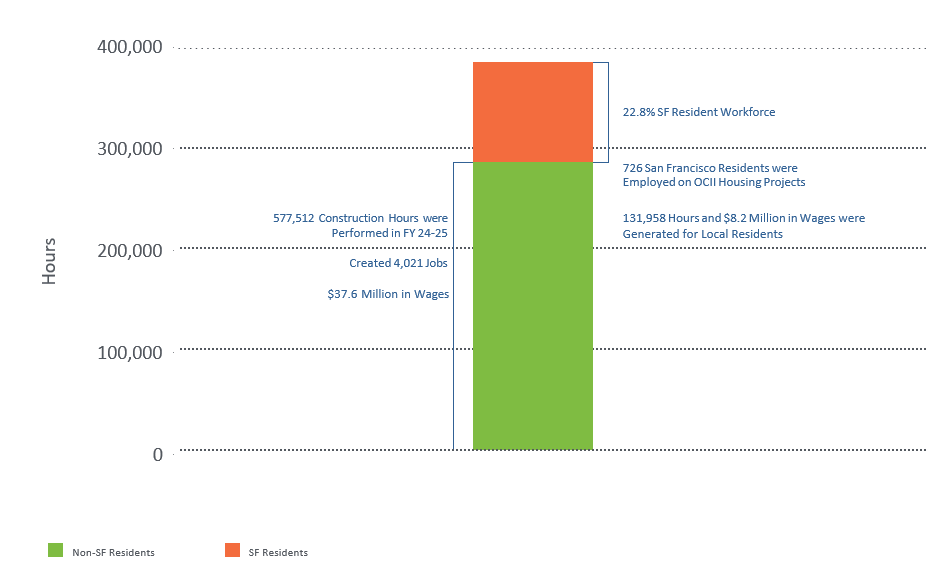
On OCII-sponsored affordable and inclusionary housing projects in FY 24-25, OCII’s Local Construction Workforce Hiring Program created 4,021 construction jobs, of which 726 were filled by San Francisco residents, yielding an overall local workforce participation rate of 22.8%, as measured by work hours. In addition, the figures represent 131,958 hours of work performed by San Francisco residents and $8.2 million in wages paid to local residents (See Chart 2).
CHART 2: Construction Work Opportunities Created by OCII Affordable & Inclusionary Housing Projects
FY 24-25